
The horrors of late-stage capitalism.
Laws that are taking away rights.
Genocide and war crimes.
Natural disasters.
And we have a front row seat to it all thanks to social media and our phones always in hand.

The world feels like it’s collapsing and you just can’t stop doomscrolling. Staying informed, while important, leads us into a never-ending stream of depressing news. Right now, thinking about doing anything feels aspirational- why do I need to take care of myself when all this is happening?
I’m here to tell you that carving out time to take care of yourself IS important, and honestly even more important when everything is more stressful.
Whether you’re feeling constantly on edge or like you’re so tired you can’t even get out of bed, exercise can actually help you!
Exercise Can Help
Being able to continue to function when you’re spiraling about the state of the world has a lot to do with nervous system regulation. This means you’re balancing your body’s response to stress to be calmer, more intentional about what you do, and more engaged with others.
Sometimes the best thing you can do when you’re too in your head is get into your body! Exercise is a tried and true method of nervous system regulation.
Lots of times, we think about exercise as a chore, something we’re “supposed” to be doing that is specific and difficult. It feels like it only adds to all the other stress you’re experiencing. In reality, movement has been helping people for a long time. When we bring the focus to how exercise can actually support us and help us feel better, it becomes less of a chore and more of a supportive part of our lives.
The Window of Tolerance
The window of tolerance is a concept that describes your nervous system. You have your own unique window of tolerance- that’s where you feel stable, you’re able to learn and complete tasks, you feel engaged. This is where your nervous system is regulated.
The window of tolerance concept is used a lot when talking about trauma, but it also comes into play during stressful times. Things like watching stressful news cycles can push you out of your window of tolerance into hyperarousal or hypoarousal, generally referred to as nervous system dysregulation.
When you’re pushed out of your window of tolerance, you can become:
- hypERaroused: panicked, anxious, agitated, etc.
- hypOaroused: lethargic, disconnected, numb, etc.
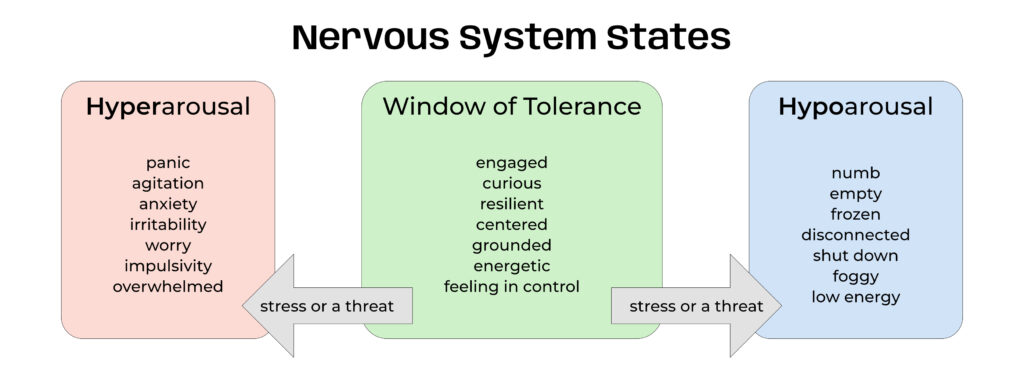
Your window of tolerance might be narrower if things throw you off easily, or it might be wider if it takes a lot to bother you. The size of your window of tolerance can also expand or shrink depending on what’s happening. Examples of things that shrink your window of tolerance: constant bad news, poor sleep, grief, anxiety, stress, or pressure.
Everyone’s window of tolerance is different! Your body may not respond like someone else’s, and that’s okay! The goal is to work on listening to how YOUR body is responding to what’s happening and be able to act in a way that helps you feel supported.
Here’s how exercise can help when you’re feeling dysregulated:
Exercise + Hyperarousal
When you’re feeling anxious or constantly on alert, engaging in higher-intensity exercise can help you burn off energy and release endorphins.
Exercise Suggestions:
- tossing a small ball from hand to hand
- HIIT-style workouts
- dynamic exercises like kettlebell swings, ball slams, sprints, etc.
- compound exercises like deadlifts, squats, and rows (any of the five basic strength exercises)
You can also try activities that help you slow down:
- yoga
- breathwork
- mindfulness exercises
Exercise + Hypoarousal
When you feel disconnected and sluggish, it might feel tough to do any sort of exercise at all. You might feel a lot of resistance to start moving, and that’s okay! You don’t have to do a lot or be excited about exercise for it to be beneficial.
➡️ I actually love this trend because it’s normalizing we don’t always have to feel great or be perky when we’re moving.
For hypoarousal, it can be helpful to focus on smaller movements. Depending on what you choose, it can stimulate your senses or help bring your focus back into your body.
Exercise Suggestions:
- balance drills (this is one of my favorites)
- slow movements, like restorative yoga poses or gentle stretching
- smaller, single joint exercises like bicep curls, tricep extensions, calf raises, etc.
- deep breathing
You can also move in a way that will raise your heart rate:
- dancing to upbeat music
- a walk (as seen in the video above)
*When choosing from these suggestions or looking for other options, I recommend choosing what’s already familiar to you. It’s much tougher to learn something new when you’re hyper- or hypoaroused.
If you already have a regular workout routine, you can use these suggestions to help you adjust your workout when you’re feeling dysregulated. Instead of ditching your workout completely and continuing to spiral, you can use it to change the trajectory of your day. Trying to exercise like it’s any old day isn’t going to work.
Listening to Your Body
When you’re hyper- or hypoaroused, it can be easy to ignore your body’s feelings and needs. Getting into the habit of checking in with yourself frequently can be helpful here, especially when something bad is on the news or you recognize that you’re doomscrolling. Listening to your body is a huge part of deep health (the idea of being healthier in all parts of your life- physically, mentally, emotionally, and socially) and an important life skill.
When you start to be able to recognize when you’re hyper- or hypoaroused, you give yourself the power to do something about it, like engage with the exercises above.
Remember: YOU are the expert of your body! The key is to get used to listening to it and actually letting it guide your actions. When there’s so much going on, it’s easy to push past what your body needs and instead do what you think “should” happen.
Here are three steps you can use to help you practice listening to your body:
1. Do a body scan.
A body scan is a helpful tool for guiding you step-by-step through the current feelings of your body. These feelings could be physical (my chest feels tight), mental (my thoughts are spinning nonstop), or emotional (I feel sad). Awareness is the key here and step one for shifting out of dysregulation.
Try a body scan worksheet or a body scan meditation like this one.
2. Hone in on what your feelings are.
Once you’re aware something is up, the next step is to give it more shape. This can help you determine whether you’re hyperaroused or hypoaroused instead of just saying the more ambiguous “I feel bad.” Try using an emotion wheel to help you get more specific about your feelings if you’re unsure. What your body wants is extra helpful here: do you want to curl up in a ball and sleep, or do you feel like you just can’t relax?
3. Take action!
Now that you’re aware and you know whether you’re feeling hyper- or hypoaroused, it’s time to work on regulating your nervous system! Go to the lists above and choose an activity. Don’t put pressure on yourself to do a whole workout, start with a couple minutes and see how you feel afterwards.
Remember there are no set answers for these- there’s a lot of overlap between what you can do if you’re hyper- or hypoaroused. It’s up to you to try things and see what you respond to best! When you’re hyperaroused, you might love jumping around instead of breathwork. If you’re hypoaroused, you might prefer small exercises instead of stretching.
Keep in mind that all of this is a suggestion and none of it is foolproof. There are no “shoulds” or “have-tos” here. You can always make a different decision and choose movement that feels best for you.
Having the Capacity to Make a Difference
Let’s to back to the beginning: why does taking care of myself even matter when everything is bad?
Hopefully by this point, you’re starting to understand the answer. When your nervous system is regulated (at least more frequently than not), you have way more capacity to do things and engage than when you’re dysregulated.
You’re able to take action. You’re able to engage with your community. You’re able to help enact change. And what the world needs right now is YOU out there helping to change things!
Want more content like this? Get strength tips, fitness mindset tips, and new blog articles delivered to your inbox every other week by signing up for my newsletter, Strength Notes. Sign up here.
Sarah Siertle

Hey! I'm Sarah!
I'm an inclusive strength & movement coach who helps people get hella strong so they can have fun and live their lives in full color!
My coaching is beginner-friendly, movement-based, and size-inclusive. I believe in coaching that is kind, not shaming or judgmental as so many fitness experiences are.
If you're ready to start your strength journey, you can check out your training options or get five days of five-minute workouts for free!

Comments